

Too Full to Function
What happens when there's no space left inside


One of the books that has had, and continues to have, a profound impact on my life and way of being in the world, is the Tao Te Ching by Lao Tzu. So each month I am exploring a chapter of this book and how we can use its wisdom in our writing, and lives, today.
I hope you enjoy it. I’d love to hear from you with your comments and ideas. This month’s translation is from the Stephen Mitchell translation.
11
We join spokes together in a wheel,
but it is the center hole
that makes the wagon move.
We shape clay into a pot,
but it is the emptiness inside
that holds whatever we want.
We hammer wood for a house,
but it is the inner space
that makes it livable.
We work with being,
but non-being is what we use.

This chapter flips our usual way of thinking on its head. We all automatically focus on the solid things that we can see and touch — the spokes, the clay, the wood. We accumulate possessions, fill our schedules, even when we go on holiday we pack every moment with sightseeing and activities. We've forgotten how to look beyond the material. To see that it's the emptiness that makes everything work. The space. The void at the centre.
It’s as if modern life has declared war on emptiness, alongside all the other made-up wars — the war on terror, the war on drugs, and on and on and on. We find it so hard to sit with silence. We can’t tolerate boredom. Every moment must be filled with something — scrolling, consuming, producing, doing. The second there’s a gap in our day, we reach for our phones. The moment a conversation goes quiet, we rush to fill it. We’ve been programmed to feel that empty time is wasted time. Empty space in a schedule is failure.
I still get caught in this myself, even after years of mindfulness practice. The conditioning to fill every moment is so ingrained. When I sit down to meditate and encounter the emptiness there, my mind immediately tries to populate it with thoughts, plans, worries. When I finish one task, I often reach for the next before I’ve even taken a breath. The stillness, the quiet, the space between — these can feel dangerous somehow. Like if we let ourselves stop, we’ll disappear.
But the truth is the opposite. Without emptiness, we lose ourselves. Through all this constant busyness and consuming we become like the drawer in the house where everything gets stuffed to tidy it away. Solid pots with no space left inside to hold anything real. A house with walls but no rooms to live in.
Living nomadically with minimal possessions for the past 13 years has taught me about the value of empty space. We own very little. Our lives aren’t cluttered with stuff. And that emptiness is what gives us room to breathe and reflect. If we filled every space with possessions, packed every corner, accumulated until there was no room left, we wouldn’t be able to look beyond it all to what really matters.
The same is true with time. When every hour is scheduled, every moment accounted for, there’s no space for life to just happen. No room for spontaneity, for rest, for simply being. We become exhausted husks going through the motions because we’re too afraid of there being emptiness at our centre and having to sit with it.
My meditation practice is training in being with the emptiness. Sitting with the void without filling it. Breathing into the space between thoughts. Allowing silence to exist without rushing to fill it with noise. It’s harder than it sounds. Our culture has taught us to fear emptiness so deeply that encountering it feels like falling into a pit.
But what I’ve realised is that the emptiness isn’t the pit. The overfilled life is the pit. When we have no space left, no room to breathe, no center of stillness that’s when we fall apart. That’s when we lose ourselves entirely.
So how does all of this apply to storytelling? Let’s read a story that shows us what happens when someone has been so overfilled, for so long, that there’s no emptiness left.

Reading
The Pit by Erin Dawkins
Synopsis
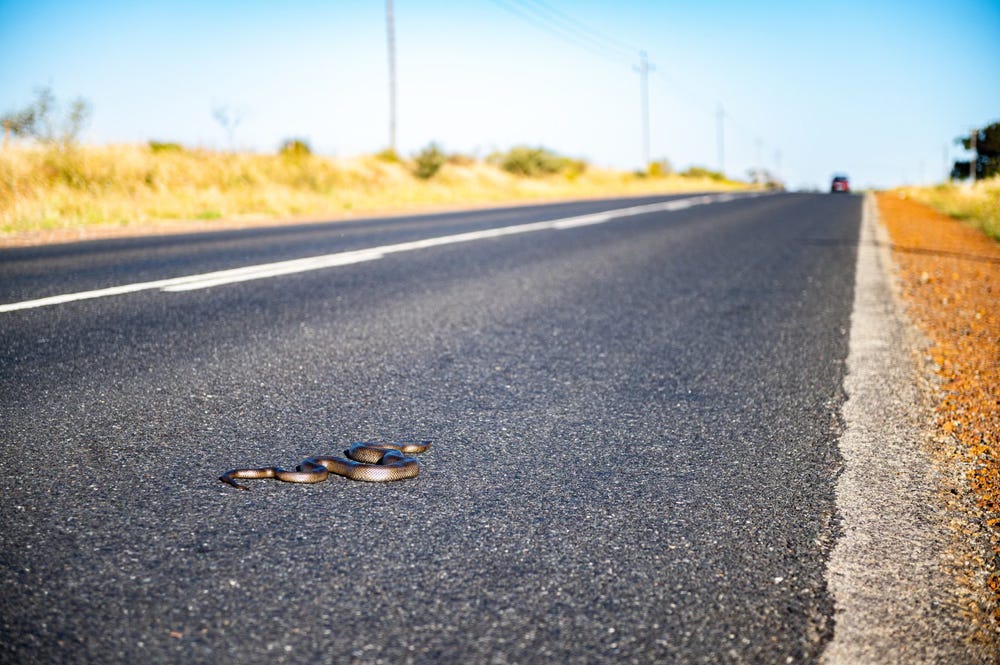
Eleanor and her family are driving to the home they’ve booked for their vacation when a truck in front of them releases hundreds of snakes onto their car. The family escapes, traumatised but physically safe, and continues to their rental home — View Villa on Lake Superior.
But Eleanor can’t escape the snakes. When she unpacks and steps on something that moves under her foot she’s convinced it’s a snake, though it turns out to be a modem cable. At dinner, she cuts into the chicken and sees snake scales instead of skin. Her husband Ray dismisses her, takes the children for ice cream while she “collects herself.”
But then Eleanor sees snake tracks all over the beach. She drags her young son Henry away, terrified. But when Ray comes to look, there are no tracks — only their footprints. Eleanor is seeing snakes everywhere. Filling every empty space with her worst fears.
By the end of the story, Eleanor stands inside View Villa looking out at her family who stand in the tall grass, backing away from her. Recoiling when she presses her palm to the glass. They’re outside. She’s inside. Separated by a window.
I chose this story because Erin Dawkins captures something deeply unsettling about what happens when we have no inner space left. When we’ve been so overfilled, for so long, that we can no longer function.
Eleanor explicitly tells us she’s exhausted and shutting down. “I shut down. Because the yelling wasn’t just occasional, it was constant. My energy was non-existent. I was having a hard time keeping up.” Ray suggests a vacation, but Eleanor knows: “Sure, we were on vacation from work, but life still required attention. At View Villa, I would need to cook and clean. I would need to hang wet bathing suits from bathroom rods. We would still need groceries throughout the week.”
There is no emptiness. No rest. No space to breathe. The vacation just moves the same demands to a different location. She’s already exhausted before they even arrive.
And then there are the snakes — the actual snakes that fall from the truck, and the snakes she starts seeing everywhere. A cable on the floor feels like it’s moving under her foot. Snake. Chicken skin looks like scales. Snakes. Zigzag patterns on the beach from wind or tide become snake tracks. Snakes.
Eleanor has no internal emptiness left to process reality accurately. She’s so overfilled with exhaustion and demands that she’s lost her centre - the space that would let her see a cable as a cable, chicken as chicken, wind patterns as wind patterns. Without that inner void, she can’t hold anything real. She can only project her terror onto everything around her.
This Tao Te Ching chapter tells us that emptiness is what makes things useful. The hole in the centre of the wheel makes it roll. The space inside the pot lets it hold water. The empty rooms in a house make it livable.
Eleanor has no empty space left. She’s been filled to capacity with demands and responsibilities and the constant need to keep up, to cope, to manage. And without that emptiness at her centre, she’s become unstable. By the end, her own family can’t live with her anymore. They stand outside in the grass, backing away.
The title “The Pit” is perfect. Eleanor is falling into a void. But it’s not the emptiness itself that’s destroying her, it’s that she’s been so overfilled for so long that when she finally cracks, there’s no centre to hold her together. She’s lost the emptiness that would have made her stable.
Erin Dawkins doesn’t moralise about this. She doesn’t tell us Eleanor should have said no more often, should have set boundaries, should have rested. She just shows us what happens. This is horror as warning. This is what we become when we ignore the wisdom of emptiness.
The story also captures our cultural terror of the void. We’d rather see snakes than nothingness. We’d rather populate empty space with our worst fears than let it remain empty. Because emptiness feels like the pit we’ll fall into. But really, the pit is the overfilled life that leaves no room for living.
What would Eleanor’s life look like if she had emptiness at her center? If she had space to breathe, to rest, to simply be? We don’t know. The story doesn’t show us that alternative. It only shows us the horror of what happens without it.
For writers, the question becomes: How do we create space in our work and our lives? How do we resist the pressure to fill every moment, every schedule, every silence? How do we practice being with emptiness rather than running from it?
This chapter teaches that non-being is what we use. Not the spokes, but the hole. Not the clay, but the space inside. Not the wood, but the rooms. We work with being, but it’s the emptiness that makes everything work.
Eleanor forgot this. Or maybe she never knew it. And by the end, she’s lost her family, lost herself, lost the ability to distinguish reality from hallucination. All because there was no space left. No emptiness to keep her balanced.
Please do let me know in the comments, or by replying to the email, your thoughts and feelings about this story; and how it ties into this interpretation of the Tao Te Ching for our modern lives and storytelling.
Your Turn: Writing Prompts
Personal Prompts
Look at your schedule for the past week. Where is the empty space? Where is the silence, the rest, the room to breathe? If there isn’t any, write about what you’re afraid will happen if you create it.
Write about a time when you tried to fill empty space (silence in conversation, free time, a quiet moment) with something - anything - rather than let it remain empty. What were you running from?
Describe what emptiness feels like in your body. Where do you hold it? What happens when you encounter it? Do you fill it immediately or can you sit with it?
Fiction Prompts
Write a character who has no empty space left in their life. Show the moment when they start to break down. What do they see or do that reveals they’ve lost their center?
Create a story where silence or empty space becomes a character itself. How do the other characters react to it? Do they try to fill it or can they tolerate it?
Write about someone who is terrified of emptiness and someone who embraces it. Put them in a situation where they must wait together in silence. What happens?
I’d love to hear what comes up for you with these prompts if you’d like to share in the comments.
I hope you’ve enjoyed this month’s Storytelling with the Tao Te Ching. You can read the other posts in this series here.
With love,

Write With Me

The Writing Sangha is my brand new women-only membership community for mindful writing practice. We gather weekly for Writing Hours and monthly for deeper circles exploring themes like moving from limiting beliefs to limitless self. A place to write, reflect, and connect with other women on the path. Info here.
Plus I have two mindful writing Zoom workshops coming up. Find out more here.
When my son moved to the US, we went to the phone company together so I could transfer my contract to his name. The salesperson was excited to offer him a special deal promising, "If you sign up today, you'll get a free tablet." My son said he didn't want a tablet. The salesperson flinched, "But it comes with some awesome free games as well!" "That's exactly why I don't want it" my son deadpanned, and we walked away with the simple transfer we had requested. Later, he explained to me that he wanted to build a meaningful life in his new home and that it wouldn't be possible if he kept himself endlessly entertained. At the wise old age of 19, he knew that his spirit needed emptiness to grow. Boredom eventually lead him to become a community gardener, bee-keeper, tree-keeper, burn-team member, mushroom forager, and overall thriving member of the sustainable living community of which has become a prominent member.